
The Left Behind
One of the Many Groups Losing Out in the March of 'Progress'

Last week I was sitting in a hospital waiting room while my elderly da was having a scan and a procedure. An older lady was already there when I walked in. She was not bent over a smartphone, as most people are when faced with indeterminate empty minutes ahead, no she was crocheting.
She looked as though she might have belonged to the Brethren church. Her long, undyed hair was tied up in a bun. She wore a long denim skirt, no make-up, and had the serious look of a wee woman who had never felt much need to follow the fashions of the world around her. I said hello and commented on the heat. The sun was streaming through the windows, turning the waiting room into a greenhouse.
“We could grow tomatoes in here,” I said.
She laughed, and the moment she replied I knew the accent, like myself, East Antrim. We spoke in the same dialect/accent, so that was us off to a good start. Hospitals are strange places for conversation. We spoke about the weather and the hospital, then somehow wandered onto technology, social media and government control. I am sure some of the people passing through were entertained by us, or at least those who could understand our lingo.
What stayed with me was our conversation about older people and the brave new world being built around them.
There’s an app for that!
Everything now seems to require a smartphone, an app, an email address, a password or a verification code. Banking, medical appointments, insurance, car tax, travel, parking and contact with public services have all been dragged online. We are told this makes life easier, and perhaps it does for those with the devices and confidence required. For everyone else, this so-called ‘progress’ feels like exclusion.
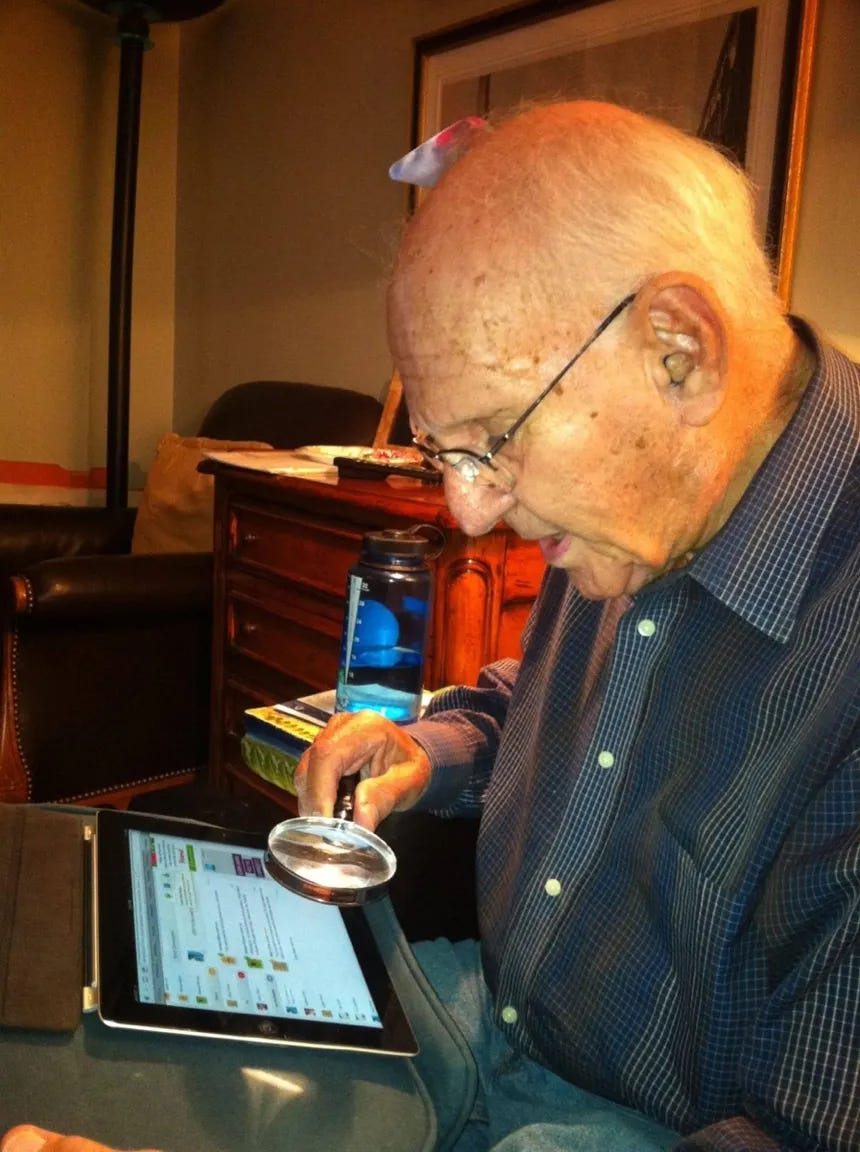
We agreed on every point, mostly because we had seen it in our own lives, and the lives of our families. Both my father and my father-in-law have suffered strokes, my da’s a lot more severe than my father-in-law’s. Neither can navigate the technology now demanded for the most basic parts of life. My mother and mother-in-law cannot manage smartphones or the internet either. They are not simply reluctant users; they are unable to do what the new systems require. As a result, they depend upon us for almost everything. We tax and insure their cars (my in-laws still drive), deal with online accounts, book appointments, complete forms and arrange any holidays they wish to take. An official letter tells them to visit a website, so one of us must visit it. A company sends a code to a phone they cannot operate, so one of us must operate it.
All the banks in their local towns have closed. Thankfully, my in-laws can still drive the ten miles to the nearest branch, although we must first go online to tax and insure the car that takes them there. My own parents must rely on my brother and me.
These are not people who have always been helpless. They worked, raised families, managed homes, paid bills and coped with all the trials ordinary life placed before them. Yet the world has removed the methods by which they once managed their own affairs, and now treats their dependence as a personal failing.
Ivan Illich wrote: “People need new tools to work with rather than tools that ‘work’ for them.” A good tool enlarges a person’s freedom. A bad system may look impressive while leaving the human being smaller and more dependent than before.
The same can be seen in the spread of self-service tills, one of my great bugbears. Neither of my parents would have the first clue how to navigate them. They would face flashing instructions and the inevitable “unexpected item in the bagging area”, before a member of staff was summoned to help them operate the machine that replaced the member of staff who once served them.
If you enjoy or get something out of my work but can’t quite stretch to a full paid subscription each month (I know the feeling) or if you just want to bless me with a one off gift, you can always throw a wee donation my way over on Buy Me a Coffee/beer. A big thanks to those who already have, it really does mean a lot and helps more than you’d think.
This is called efficiency.
Jacques Ellul observed: “Our civilization is first and foremost a civilization of means; in the reality of modern life, the means, it would seem, are more important than the ends.” The purpose of a shop should be to serve the customer, a bank to help people manage their money, and technology to assist human beings. Yet the system increasingly becomes the master, and the person must adapt to it or be excluded.
Lewis Mumford used the term “megamachine” for vast systems in which human beings become little more than components. Institutions begin to treat people as though they ought to behave like machines: quick, standardised, permanently connected and free of awkward human limitations.
Old age exposes the cruelty in that assumption.
There should always be another way. A telephone answered by a human being. A staffed checkout, a cash option, a paper form, a local bank branch. A desk where someone can explain, a little patience for those whose eyes, hands, memories or minds cannot keep pace. Such things are dismissed as inefficient, but human dignity has never been especially efficient.
Eventually (mid conversation) a nurse appeared, and asked whether I would come in to collect my da and hear how the procedure had gone. He cannot understand much of what is said to him now, particularly medical information, so I have to be there to listen, and make sure nothing important is missed. I gathered my things and said goodbye to the old lady. I wished her God’s blessing and a safe journey home.
There was something fitting about the way our conversation ended. I had to leave because my own elderly father needed me to understand what he could no longer understand for himself. The dependence we had been discussing was waiting for me on the other side of the door.
I do not know the old lady’s name, and I will probably never see her again. But I can still picture her beneath those great big windows, crocheting quietly while the modern world rushed on around her.
The march of progress is loud. It celebrates every new app, machine and labour-saving system. Perhaps, every now and then, we should stop marching, turn around and ask who we have left behind.
Another Beer Run and an Octogenarian Ally
I finished work before lunchtime today, (Thursday 23rd) and took the opportunity to write the above. Having finished my first draft, I took my daughter out for a very brief beginner’s driving lesson. After that, I decided to go on what is now becoming a weekly Thursday beer run.
Remember last week’s? Well, this one was much more wholesome, and more informative.
I went to a different supermarket to grab a case of beer, ensuring I would have cold beer at the end of play on Friday. Only one of the ten staffed checkouts was open, so I joined the queue. There happened to be an old lady in her eighties in front of me, so I did what I usually do: I started gabbing.
She began giving off about those hellish self-service tills. She refuses to use them, always pays in cash and finds card payments confusing. She had even had money stolen from her bank account somehow, so she no longer uses her card when she is out.
Again not forty minutes earlier, I had finished writing everything above.
We whinged and moaned together while having a laugh, and then off she went. The checkout lady, herself in her mid-sixties, had obviously heard our conversation, because she immediately started giving off about the tills not being open and about being left there on her own.
She moved on to the minimum wage, saying that every time it goes up, another checkout closes. She mentioned something about tax codes, but she was speaking with such venom and speed that I missed part of it. At the tail end, she said:
“By 2030 or 2031, all these tills will be gone, and it will only be self-service checkouts.”
I replied that the shop up the road seemed to be five years ahead of schedule.
I collected my beer, and my crisps, and headed towards the car park. I caught up with the old dear who had been in front of me, sneaked up behind her and told her that the big security guard was looking for her. It was probably, I suggested, because she had hidden a large bottle of vodka beneath her handbag.
She burst out laughing, and we went our separate ways.
The whole encounter hammered home what I had written only minutes before. It also highlighted something else: the very human exchange we had enjoyed would have been impossible at a self-service checkout.
“Freedom and dignity will continue to dissolve into an unprecedented enslavement of man to his tools.”
Ivan Illich
I want to keep this work free and outside paywalls. That matters to me, however that means relying on the support of you my readers. I’m not a brand, public figure, or celeb, I’m a working man (painter/handyman/labourer) trying to write carefully and independently. If this work has meant something to you, a paid subscription is one way to help keep it going. Paid Subscriptions have gone down lately, but I’m genuinely grateful for all of you who have.
I used to abhor conversations with strangers (conceding I'm excessively private), heightened by a few unfortunate experiences and an early phase of my career often trapped in airplane seats for 6-14 hour flights beside chatty company. As my mom aged and I spent more time with her on errands and whatnot, I began to see every "little old lady" as my mom. Now all of my old people are passed away, and I'm more than delighted to pass the time with any friendly soul, especially the 'well seasoned', while we navigate the world. My brilliant dad found it hilarious in later years to wear a pin: "Too soon old, Too late smart" and of course I have it now.
Digital exclusion is a real problem. We are being railroaded imho into a society where certain digital modalities are being pushed onto populations without consideration for whether it is appropriate for their needs. Some cohorts within those populations will be disproportionately affected, like the very young and the elderly but this does not seem to matter to those who are rolling out these technologies. (This might all seem like corporate speak for the obvious, but imho it is important to push back against these trends using language that they understand)
(If you want peak lunacy I recently came across the term 'natural person' on an Irish government website, as opposed to the 'corporate person' and the 'legal person', prioritising legal fictions over real live human beings).